Key takeaway
Do these four things this week, in this order: document the job state today with dated photos and video, stop all payments immediately, check whether the contractor holds a valid DCWP license, and terminate the contract in writing before anyone new touches the apartment. Then get the remaining work assessed by someone willing to open up what was covered. Do not let a new contractor quote a takeover over the phone.
If your job is sitting unfinished, call us.
Free on-site estimate. Written, fixed-price quote within 48 hours, or take $250 off.
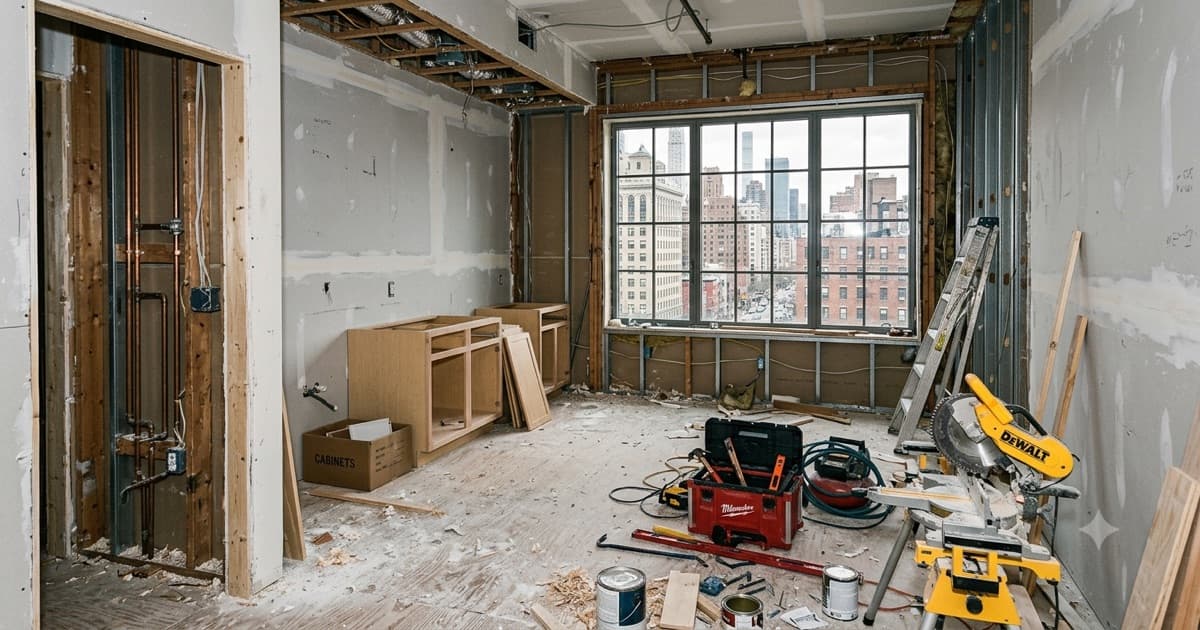
1. Document everything today, before anything changes
This is the step people skip because they are angry and want to move. Do it first anyway. Within the next 24 hours:
- Photograph and video every room, wide and close, with the date visible. Open cabinets, open the panel, get into whatever is exposed.
- Photograph anything that is open, walls, floors, ceilings. Once a new contractor closes it, your evidence is gone.
- Inventory the materials on site. What did you pay for that is physically there, and what did you pay for that is not.
- Assemble the paper. Contract, every change order, every invoice, every payment record, and every text and email. Screenshot the texts. Do not rely on your phone still having them in six months.
- Write a dated timeline. When work started, when it slowed, when they last showed up, when you last heard from them.
If you do nothing else from this page, do this. Every route you might take later, mediation, small claims, a trust fund claim, an insurance question, depends on evidence that exists right now and will not exist after the next crew starts work.
2. Stop paying, and check the license
Stop all further payments immediately. Do not send another dollar in response to a promise to return. If there is a scheduled payment tied to a milestone that was not met, it is not due.
Then check the license. Home improvement contractors working in the five boroughs are required to be licensed by the NYC Department of Consumer and Worker Protection, and you can look up any license and its complaint history for free.
This matters more than almost anything else on this page, because it determines what recourse you have.
If they were licensed: you can file a complaint with DCWP, which runs a mediation process. Licensed contractors are also backed by the city’s Home Improvement Contractor Trust Fund, which provides a route to limited restitution when a licensed contractor takes your money and does not deliver. The amount is capped and the process is not fast, but it exists.
If they were not licensed: the trust fund is not available to you. Your realistic options are small claims court, which in New York City handles claims up to $10,000, or civil court and an attorney above that.
There is an uncomfortable lesson in that gap, and it is the reason we volunteer our license number and our insurance certificates before anyone signs anything.
3. The lien exposure most people do not see coming
Two separate risks here, and both are worth understanding before you hire anyone else.
Your contractor may file a lien against you.In New York, mechanic’s liens must generally be filed within eight months of the last date of work, or four months on single-family dwellings. Courts have held that where a contractor abandoned the contract, that clock runs from the date of abandonment rather than from any later token visit. So the contractor who walked off in March may still surface with a filing.
Their unpaid subcontractors may also file. If the contractor collected your money and did not pay the plumber, the electrician, or the cabinet supplier, those parties have their own lien rights even without a direct contract with you. This is the one that blindsides people, because they have never met the person filing against them.
Whether a lien can actually attach to your home depends on whether you own a condo unit or co-op shares, and that is a real legal distinction with real consequences.
This is the point where you need a construction attorney, not a contractor. We can tell you what it takes to finish your apartment. We cannot tell you what to do about a lien, and any contractor who offers to is out of their depth. If you have received any lien notice, call a lawyer before you call us.
4. Terminate in writing before anyone new starts
Read your contract for a termination clause. Most have one, usually with a notice period and a required method of delivery.
Send written notice, keep proof of delivery, and state plainly that the contract is terminated for non-performance as of a specific date. Do not send anything angry, do not accuse, and do not discuss what you intend to do next. Short and factual.
Only after that should another contractor begin work. Starting new work under a live contract muddies your position considerably.
What a takeover actually involves
Here is why many contractors will not touch these jobs, stated honestly rather than diplomatically.
When we finish someone else’s renovation, we inherit everything. Framing that may not be square. Plumbing rough-in we did not do and cannot see. Electrical that may or may not have been filed. Work that may not meet your building’s requirements. And when it is done, it is ours. Our name is on it and our warranty covers it. This applies to kitchen remodeling, bathroom renovations, and every other scope we take over.
So the assessment is not a formality. We open what needs opening. We check the filings. We look at whether the rough-in is sound, whether the waterproofing was ever done, whether the panel work is legitimate. Sometimes we find that most of what is there is fine and the job just stopped. Sometimes we find that a meaningful portion has to come out.
We will not quote a takeover over the phone, and neither should anyone else. A number given before anyone has looked inside the walls is a number that will change.
What it costs to finish an abandoned job
Expect 15 to 35 percent more than the remaining work would have cost inside a clean project. That premium covers:
- Assessment and investigation time
- Correcting work that does not meet code or building requirements
- Re-filing where the original filings were never made or were made improperly
- Redoing work nobody will warranty as-is
Occasionally it is less than 15 percent, when the previous crew was competent and simply stopped. It is rarely nothing. For comparison, see what a kitchen renovation costs as a clean-project baseline.
What we will not do is take the job, start work, and discover the problems at your expense in a stream of change orders. The assessment happens first, the number is fixed, and it is in writing.
One thing worth saying
The founder of this company started it because a contractor did this to him, in his own apartment on East 9th Street, in 2014. Everything about how this business operates, the fixed-price quotes, the no-deposit policy, the phones answered seven days a week, exists because of that job.
We know exactly what week you are having. Call when you are ready.
This page is general information about a common situation, not legal advice. If a lien has been filed against your home or you are considering a claim, speak with a construction attorney.
If your job is sitting unfinished, call us.
Free on-site estimate. Written, fixed-price quote within 48 hours, or take $250 off.
Frequently asked questions
Can I just hire someone else to finish the work?
Usually yes, but terminate the original contract in writing first and document the state of the job before anyone new touches it. If you skip that step you lose your evidence and you make any later claim much harder. Most contracts also have a termination clause with a notice period. Read it before you act.Will a new contractor take over someone else's unfinished job?
Some will, many will not. The reluctance is real: we inherit whatever is behind the walls and whatever was done wrong, and we are the ones who own it afterward. We do take these jobs. We price them after a full assessment, never over the phone, because nobody can quote a takeover responsibly without opening it up first.How much more does it cost to finish an abandoned renovation?
Expect 15 to 35 percent above what the remaining work would have cost as part of a clean project. That premium covers assessment time, correcting work that does not meet code or building requirements, and the fact that nobody will warranty another contractor's work. Occasionally it is less. It is rarely nothing.Can I get my deposit back?
Sometimes, and it depends heavily on whether the contractor held a valid DCWP home improvement contractor license. Licensed contractors are backed by the city's Home Improvement Contractor Trust Fund, which offers a route to limited restitution. Unlicensed contractors leave you with court as the main option.Can a contractor who abandoned the job still file a lien against me?
They can attempt to. In New York, mechanic's lien deadlines generally run from the last date of work, and courts have held that where a contract was abandoned by the contractor, the clock runs from the date of abandonment. Whether a lien can attach at all depends on whether you own a condo or co-op shares, which is a genuine legal distinction. Talk to a construction attorney, not to your next contractor.
Free on-site estimate. Fixed-price quote in 48 hours.
No deposit required. Written workmanship guarantee on every job. We answer phones 7 days a week, 7am to 7pm.
★ Miss the 48-hour deadline? Take $250 off your project.